
4130 and 4140 are both highly representative heat treatable low-alloy steels (HTLA) in engineering, with similar compositions, but often undertake different tasks in practical applications. 4130 is commonly used in pipes, frames, and welded structures, while 4140 is more commonly used in high load parts such as shafts, gears, and pin shafts.
What is the difference between the two? Ultimately, it lies in the deep influence of carbon and manganese content on material strength, hardenability, weldability, and cutting performance.
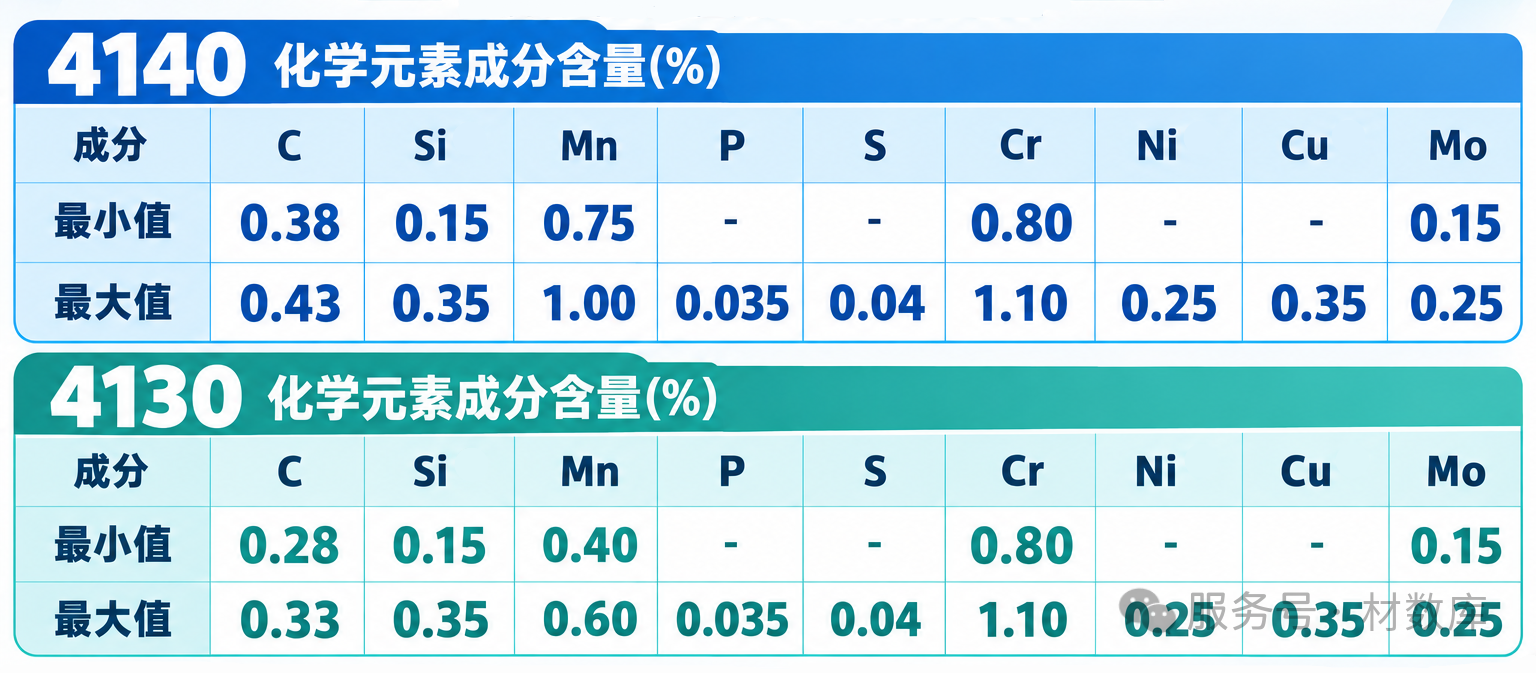
Carbon content (C): The carbon content of 4140 has increased by about 0.10% compared to 4130. This increment significantly enhances the martensitic hardening ability and fatigue limit after austenitization quenching, but sacrifices some fracture toughness and welding margin.
Manganese content (Mn): The upper limit of manganese content for 4140 reaches 1.00% (the upper limit for 4130 is only 0.60%). In heat treatment metallurgy, manganese can effectively delay the pearlite transformation of undercooled austenite, greatly improve hardenability, ensure the formation of uniform tempered martensite/martensite structure from the surface to the inside of large section parts, and effectively avoid the common problems of "core quenching failure and soft hardness" of 4130 in thick walled workpiec
2、 Deep analysis of mechanical properties
Strength and fatigue life: Under similar heat treatment conditions, the tensile strength of 4140 is about 15-30% higher than that of 4130. A higher carbon content results in more complete martensitic transformation, directly transforming into higher hardness and load-bearing capacity. For shafts, gears, and rotating components under high cyclic loads, this strength advantage is directly reflected in longer fatigue life.
Hardness and Wear Resistance: After 4140 quenching and tempering, the hardness is extremely abundant, and excellent wear-resistant shell can be obtained after surface induction hardening or nitriding, suitable for bearing necks and friction sliding pairs; 4130 hardness has relatively limited potential and is generally not the preferred choice for heavy load wear.
Resilience and impact toughness: 4130 has low carbon content, moderate hardness of quenched structure, and high fracture toughness. In the pipe frame structure resistant to multi axis impact loads, 4130 can undergo micro plastic deformation without brittle cracking. When facing alternating vibration or low-temperature impact conditions, engineers often choose 4130 which is less prone to brittle fracture than blindly choosing high-strength 4140.
① Cutting: 4130 is easier to machine
① 可切削性评级以AISI 1212易切削钢为100%基准;具体数值会因材料状态、硬度及测试方法不同而有所差异。 | ||
Processing strategy evaluation:
4130 (normalized state, 180-200 HB): The machinability rating is about 70%, and the chips are easy to control;
4140 (annealed state, 180-220 HB): The machinability rating is about 60-65%, and the machining difficulty significantly increases after quenching, tempering, and pre hardening (>30 HRC).
② Heat treatment: 4140 has a higher upper strength limit, but deformation control is more difficult
4140: Good hardenability and deep hardening layer, but accompanied by high quenching internal stress and phase transformation microstructure stress, thin-walled irregular parts are prone to deformation and cracking during quenching. After heat treatment, grinding or precision machining allowance is usually reserved;
4130: The phase transition stress is relatively mild, the heat treatment process window is wide, the dimensional accuracy is easy to control, and the comprehensive deformation control cost of heat treatment is relatively low.
③ Welding process
4140 (high welding difficulty): High carbon and manganese content, with a very obvious tendency towards quenching hardening and cold brittleness in the heat affected zone, classified as a difficult to weld steel grade. Strict preheating, interlayer temperature maintenance, and post weld stress relief heat treatment (PWHT) must be followed.
4130 (good welding adaptability): Due to the controlled carbon content of around 0.30%, the microstructure of the heat affected zone (HAZ) is relatively flexible. Thin walled pipe components (such as aviation fittings and racing anti roll frames) require less complex pre preheating when using TIG/MIG welding. However, it is still recommended to preheat the medium thick wall (>13mm) to above 150 ℃ to prevent delayed cracking.
Recommended preheating temperature and interlayer temperature (℃)
构件截面厚度
mm4140 4130 ≤13 175~230 150~205 13~25 230~290 205~260 25~50 290~345 230~290
4、 How to choose between 4140 and 4130?
焊接结构、管材 | 含碳量较低,焊接性相对较好 | |
赛车/自行车车架 | 强度和韧性较平衡,焊接性较好 | |
Summary:
The price difference between 4130 and 4140 is relatively small, and their selection is essentially an engineering trade-off between "manufacturing process friendliness" and "part load-bearing limit". Heavy load, large cross-section, wear-resistant and with few welded parts -4140 is preferred; Lightweight structure, involving intensive welding and pipe frame assembly, pursuing toughness and energy absorption - decisively choose 4130.
Source: Material Quantity Library